Ebook Download Moonwalking With Einstein: The Art and Science of Remembering Everything, by Joshua Foer
Be the initial to obtain this publication now as well as obtain all reasons you have to read this Moonwalking With Einstein: The Art And Science Of Remembering Everything, By Joshua Foer Guide Moonwalking With Einstein: The Art And Science Of Remembering Everything, By Joshua Foer is not just for your obligations or necessity in your life. E-books will certainly always be a great friend in each time you check out. Now, let the others understand about this page. You can take the benefits as well as share it likewise for your good friends as well as individuals around you. By this method, you could really obtain the definition of this e-book Moonwalking With Einstein: The Art And Science Of Remembering Everything, By Joshua Foer profitably. Just what do you think of our idea here?
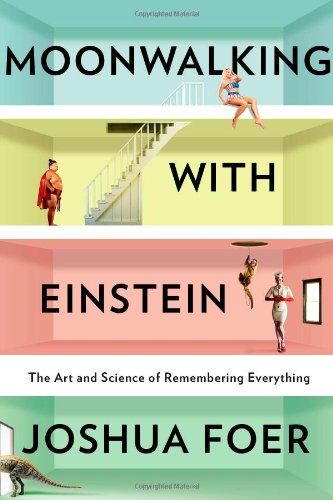
Moonwalking With Einstein: The Art and Science of Remembering Everything, by Joshua Foer

Ebook Download Moonwalking With Einstein: The Art and Science of Remembering Everything, by Joshua Foer
Moonwalking With Einstein: The Art And Science Of Remembering Everything, By Joshua Foer. Welcome to the most effective internet site that available hundreds kinds of book collections. Below, we will certainly offer all books Moonwalking With Einstein: The Art And Science Of Remembering Everything, By Joshua Foer that you need. Guides from renowned authors as well as publishers are provided. So, you could delight in currently to obtain one at a time sort of book Moonwalking With Einstein: The Art And Science Of Remembering Everything, By Joshua Foer that you will browse. Well, related to guide that you desire, is this Moonwalking With Einstein: The Art And Science Of Remembering Everything, By Joshua Foer your choice?
Just how can? Do you assume that you do not require enough time to choose purchasing e-book Moonwalking With Einstein: The Art And Science Of Remembering Everything, By Joshua Foer Never ever mind! Merely rest on your seat. Open your gadget or computer and also be on-line. You could open up or see the web link download that we supplied to obtain this Moonwalking With Einstein: The Art And Science Of Remembering Everything, By Joshua Foer By through this, you could get the on the internet book Moonwalking With Einstein: The Art And Science Of Remembering Everything, By Joshua Foer Reading guide Moonwalking With Einstein: The Art And Science Of Remembering Everything, By Joshua Foer by online could be truly done easily by saving it in your computer system and gizmo. So, you can continue every time you have downtime.
Checking out guide Moonwalking With Einstein: The Art And Science Of Remembering Everything, By Joshua Foer by on the internet can be likewise done effortlessly every where you are. It seems that waiting the bus on the shelter, hesitating the checklist for line up, or other places feasible. This Moonwalking With Einstein: The Art And Science Of Remembering Everything, By Joshua Foer could accompany you during that time. It will not make you feel weary. Besides, in this manner will certainly also enhance your life quality.
So, just be right here, locate the book Moonwalking With Einstein: The Art And Science Of Remembering Everything, By Joshua Foer now and also read that quickly. Be the first to review this book Moonwalking With Einstein: The Art And Science Of Remembering Everything, By Joshua Foer by downloading and install in the link. We have some other e-books to check out in this site. So, you can locate them additionally conveniently. Well, now we have actually done to supply you the ideal book to check out today, this Moonwalking With Einstein: The Art And Science Of Remembering Everything, By Joshua Foer is truly suitable for you. Never ignore that you need this e-book Moonwalking With Einstein: The Art And Science Of Remembering Everything, By Joshua Foer to make much better life. On the internet e-book Moonwalking With Einstein: The Art And Science Of Remembering Everything, By Joshua Foer will actually offer very easy of everything to check out as well as take the perks.
Foer's unlikely journey from chronically forgetful science journalist to U.S. Memory Champion frames a revelatory exploration of the vast, hidden impact of memory on every aspect of our lives.
On average, people squander forty days annually compensating for things they've forgotten. Joshua Foer used to be one of those people. But after a year of memory training, he found himself in the finals of the U.S. Memory Championship. Even more important, Foer found a vital truth we too often forget: In every way that matters, we are the sum of our memories.
Moonwalking with Einstein draws on cutting-edge research, a surprising cultural history of memory, and venerable tricks of the mentalist's trade to transform our understanding of human remembering. Under the tutelage of top "mental athletes," he learns ancient techniques once employed by Cicero to memorize his speeches and by Medieval scholars to memorize entire books. Using methods that have been largely forgotten, Foer discovers that we can all dramatically improve our memories.
Immersing himself obsessively in a quirky subculture of competitive memorizers, Foer learns to apply techniques that call on imagination as much as determination-showing that memorization can be anything but rote. From the PAO system, which converts numbers into lurid images, to the memory palace, in which memories are stored in the rooms of imaginary structures, Foer's experience shows that the World Memory Championships are less a test of memory than of perseverance and creativity.
Foer takes his inquiry well beyond the arena of mental athletes-across the country and deep into his own mind. In San Diego, he meets an affable old man with one of the most severe case of amnesia on record, where he learns that memory is at once more elusive and more reliable than we might think. In Salt Lake City, he swaps secrets with a savant who claims to have memorized more than nine thousand books. At a high school in the South Bronx, he finds a history teacher using twenty- five-hundred-year-old memory techniques to give his students an edge in the state Regents exam.
At a time when electronic devices have all but rendered our individual memories obsolete, Foer's bid to resurrect the forgotten art of remembering becomes an urgent quest. Moonwalking with Einstein brings Joshua Foer to the apex of the U.S. Memory Championship and readers to a profound appreciation of a gift we all possess but that too often slips our minds.
- Sales Rank: #38890 in Books
- Brand: The Penguin Press
- Published on: 2011-03-03
- Released on: 2011-03-03
- Ingredients: Example Ingredients
- Original language: English
- Number of items: 1
- Dimensions: 9.60" h x 1.13" w x 6.40" l, 1.20 pounds
- Binding: Hardcover
- 320 pages
Features
Amazon.com Review
Amazon Best Books of the Month, March 2011: Moonwalking with Einstein follows Joshua Foer's compelling journey as a participant in the U.S. Memory Championship. As a science journalist covering the competition, Foer became captivated by the secrets of the competitors, like how the current world memory champion, Ben Pridmore, could memorize the exact order of 1,528 digits in an hour. He met with individuals whose memories are truly unique—from one man whose memory only extends back to his most recent thought, to another who can memorize complex mathematical formulas without knowing any math. Brains remember visual imagery but have a harder time with other information, like lists, and so with the help of experts, Foer learned how to transform the kinds of memories he forgot into the kind his brain remembered naturally. The techniques he mastered made it easier to remember information, and Foer's story demonstrates that the tricks of the masters are accessible to anyone.
--Miriam Landis
Author Q&A with Joshua Foer
Q: First, can you explain the title of you book, Moonwalking with Einstein?
A: The title refers to a memory device I used in the US Memory Championship—specifically it's a mnemonic that helped me memorize a deck of playing cards. Moonwalking with Einstein works as a mnemonic because it's such a goofy image. Things that are weird or colorful are the most memorable. If you try to picture Albert Einstein sliding backwards across a dance floor wearing penny loafers and a diamond glove, that's pretty much unforgettable.
Q: What are the U.S. Memory Championships? How did you become involved?
A: The U.S. Memory Championship is a rather bizarre contest held each spring in New York City, in which people get together to see who can remember the most names of strangers, the most lines of poetry, the most random digits. I went to the event as a science journalist, to cover what I assumed would be the Super Bowl of savants. But when I talked to the competitors, they told me something really interesting. They weren't savants. And they didn't have photographic memories. Rather, they'd trained their memories using ancient techniques. They said anyone could do it. I was skeptical. Frankly, I didn't believe them. I said, well, if anyone can do it, could you teach me? A guy named Ed Cooke, who has one of the best trained memories in the world, took me under his wing and taught me everything he knew about memory techniques. A year later I came back to the contest, this time to try and compete, as a sort of exercise in participatory journalism. I was curious simply to see how well I'd do, but I ended up winning the contest. That really wasn't supposed to happen.
Q: What was the most surprising thing you found out about yourself competing in the Memory Championships?
A: In the process of studying these techniques, I learned something remarkable: that there's far more potential in our minds than we often give them credit for. I'm not just talking about the fact that it's possible to memorize lots of information using memory techniques. I'm talking about a lesson that is more general, and in a way much bigger: that it's possible, with training and hard work, to teach oneself to do something that might seem really difficult.
Q: Can you explain the "OK Plateau?"
A: The OK Plateau is that place we all get to where we just stop getting better at something. Take typing, for example. You might type and type and type all day long, but once you reach a certain level, you just never get appreciably faster at it. That's because it's become automatic. You've moved it to the back of your mind's filing cabinet. If you want to become a faster typer, it's possible, of course. But you've got to bring the task back under your conscious control. You've got to push yourself past where you're comfortable. You have to watch yourself fail and learn from your mistakes. That's the way to get better at anything. And it's how I improved my memory.
Q: What do you mean by saying there an "art" to memory?
A: The "art of memory" refers to a set of techniques that were invented in ancient Greece. These are the same techniques that Cicero used to memorize his speeches, and that medieval scholars used to memorize entire books. The "art" is in creating imagery in your mind that is so unusual, so colorful, so unlike anything you've ever seen before that it's unlikely to be forgotten. That's why mnemonists like to say that their skills are as much about creativity as memory.
Q: How do you think technology has affected how and what we remember?
A: Once upon a time people invested in their memories, they cultivated them. They studiously furnished their minds. They remembered. Today, of course, we've got books, and computers and smart phones to hold our memories for us. We've outsourced our memories to external devices. The result is that we no longer trust our memories. We see every small forgotten thing as evidence that they're failing us altogether. We've forgotten how to remember.
Q: What is the connection between memory and our sense of time?
A: As we get older, life seems to fly by faster and faster. That's because we structure our experience of time around memories. We remember events in relation to other events. But as we get older, and our experiences become less unique, our memories can blend together. If yesterday's lunch is indistinguishable from the one you ate the day before, it'll end up being forgotten. That's why it's so hard to remember meals. In the same way, if you're not doing things that are unique and different and memorable, this year can come to resemble the last, and end up being just as forgettable as yesterday's lunch. That's why it's so important to pack your life with interesting experiences that make your life memorable, and provide a texture to the passage of time.
Q: How is your memory now?
A: Ironically, not much better than when I started this whole journey. The techniques I learned, and used in the memory contest, are great for remembering structured information like shopping lists or phone numbers, but they don't improve any sort of underlying, generalizable memory ability. Unfortunately, I still misplace my car keys.
(Photo of Joshua Foer © Emil Salman Haaretz)
From Booklist
If you sometimes can't remember where you put your car keys or, like Foer, the car itself, don't panic. You're not alone, and you can do something about it. In this intriguing look at the nature of memory, Foer reassures us that we don't need to acquire a better memory; we just need to use the one we have more effectively. Foer introduces us to people whose memories are both astonishing, like the man who could memorize 1,528 random digits in order, and frightening, such as a man with such an extreme case of amnesia that he doesn't know his own age and can't remember that he has a memory problem. He explores various ways in which we test our memories, such as the extensive training British cabbies must undergo. He also discusses ways we can train ourselves to have better memories, like the PAO system, in which, for example, every card in a deck is associated with an image of a specific person, action, or object. An engaging, informative, and for the forgetful, encouraging book. --David Pitt
Review
"Absolutely phenomenal... Part of the beauty of this book is that it makes clear how memory and understanding are not two different things. Building up the ability to reason and the ability to retain information go hand in hand... The book reminds us that we all start off with pretty much the same tools for the most part, and we can be intentional about strengthening them, or not."—Bill Gates
“Captivating. . . His narrative is smart and funny and, like the work of Dr. Oliver Sacks, it’s informed by a humanism that enables its author to place the mysteries of the brain within a larger philosophical and cultural context.”—Michiko Kakutani, The New York Times
“His passionate and deeply engrossing book. . . is a resounding tribute to the muscularity of the mind. . .. In the end, Moonwalking with Einstein reminds us that though brain science is a wild frontier and the mechanics of memory little understood, our minds are capable of epic achievements.”—The Washington Post
“Joshua Foer’s book. . . is both fun and reassuring. All it takes to have a better memory, he contends, are a few tricks and a good erotic imagination.”—Maureen Dowd, The New York Times
“Highly entertaining.”—Adam Gopnik, The New Yorker
“It’s delightful to travel with him on this unlikely journey, and his entertaining treatment of memory as both sport and science is spot on. . .. Moonwalking with Einstein proves uplifting: It shows that with motivation, focus, and a few clever tricks, our minds can do rather extraordinary things.”—The Wall Street Journal
“It’s a terrific book: sometimes weird but mostly smart, funny, and ultimately a lovely exploration of the ways that we preserve our lives and our world in the golden amber of human memory.”—Deborah Blum, New Scientist
“Foer’s book is relevant and entertaining as he shows us ways we can unlock our own talent to remember more.”—USA Today
“A fascinating scientific analysis of mnemonic mysteries. What we remember, [Foer] says, defines who we are.”—Entertainment Weekly
“Sprightly, entertaining. . . [Foer] has a gift for communicating fairly complex ideas in a manner that is palatable without being patronizing.”—Financial Times
“[An] inspired and well-written debut book about not just memorization, but about what it means to be educated and the best way to become so, about expertise in general, and about the not-so-hidden ‘secrets’ of acquiring skills.”—The Seattle Times
“[An] instant bestseller.”—San Francisco Chronicle
“Funny, curious, erudite, and full of useful details about ancient techniques of training memory.”—The Boston Globe
“With originality, high energy, and an appealing blend of chutzpah and humility, [Foer] writes of his own adventures and probes the history and literature of memory, the science of how the brain functions, and the connections between memory, identity, and culture. . .. Moonwalking with Einstein. . . is engaging and timely.”—The Jewish Week
“A smart, thoughtful, engaging book.”—The Portland Oregonian
“Charming. . . The book is part of a grand tradition, the writer as participating athlete, reminiscent of George Plimpton taking up football in Paper Lion.”—O, The Oprah Magazine
“[A] wonderful first book.”—Newcity
“Fascinating.”—Town & Country
“For one year, Foer tried to attain total recall, extracting secrets from the top researchers, the real Rain Man, and the world’s memory champs. He triumphed, both in his quest and in this lively account, which is, no exaggeration, unforgettable.”—Parade
“In recounting his year in training for the USA Memory Championship, journalist Foer delivers a rich history of memory.”—Discover Magazine
“Foer’s history of memory is rich with information about the nature of memory and how it makes us who we are.”—Scientific American
“A brief and pithy recounting of Foer’s exploration of the fuzzy borders of his brain—a marveling at how and why it’s able to do something quite unexpected. . .. Moonwalking with Einstein fits handily inline with the recent tradition of ‘big idea’ books.”—The Millions
“An original, entertaining exploration about how and why we remember.”—Kirkus Reviews
“An engaging, informative, and for the forgetful, encouraging book.”—Booklist
“Hard to put down. . . The mind is a bigger thing than any of us realize, and Foer reminds us to keep exploring it.”—Barnes & Noble Review
“He has thought deeply about memory and his effort yields questions that are well worth reflecting on.”—The Daily Beast
“Intriguing. . . Foer does an excellent job of tracing the history of the arts of memory.”—The Forward
“The kind of nonfiction work that gets people talking. . . A highly enjoyable read.”—Thirteen.org
“You have to love a writer who employs chick-sexing to help explain human memory. Foer is a charmer, a crackling mind, a fresh wind. He approaches a complex topic with so much humanity, humor, and originality that you don’t realize how much you’re taking in and understanding. It’s kind of miraculous.”—Mary Roach, author of Packing for Mars, Bonk, Spook, and Stiff
“Moonwalking with Einstein isn’t just a splendid overview of an essential aspect of our humanity—our memory; it is also a witty and engaging account of how Foer went from being a guy with an average memory to winning the USA Memory Championship.”—Dan Ariely, professor of behavioral economics at Duke University and author of The Upside of Irrationality and Predictably Irrational
“In this marvelous book, Joshua Foer invents a new genre of nonfiction. This is a work of science journalism wrapped around an adventure story, a bildungs-roman fused to a vivid investigation of human memory. If you want to understand how we remember, and how we can all learn to remember better, then read this book.”—Jonah Lehrer, contributing editor to Wired and author of How We Decide and Proust Was a Neuroscientist
“Joshua Foer proves what few of us are willing to get our heads around: there’s more room in our brains than we ever imagined. Moonwalking with Einstein isn’t a how-to guide to remembering a name or where you put your keys. It’s a riveting exploration of humankind’s centuries-old obsession with memory, and one man’s improbable quest to master his own.”—Stefan Fatsis, author of A Few Seconds of Panic and Word Freak
Most helpful customer reviews
9 of 9 people found the following review helpful.
A fantastic, well written, story
By Al
I had originally assumed this book would divulge the secrets of an eternal memory to me; however, what I was given instead was far more insightful. This book is a wonderfully spun tale of Josh's journey to learn the secrets of our memory. He tells the reader about the history of memory and the philosophical ideologies of what memories really mean in our lives.
If you're looking for a how-to guide on memory, this is not it. Moreover, this book is about a year of Josh's life and the things he learned along the way. I would recommend this book to anyone looking for: a short read (I finished this in 2-days); a fantastic story; a introduction to memory training; or a stimuli to the question: what is memory?
Read this book, you won't be disappointed.
767 of 804 people found the following review helpful.
Amazingly Interesting and Helpful
By David Sheppard
This is one of those rare books that is not only a joy to read, but also immensely helpful. It can help all of us with something that is at once troublesome and worrisome: our memory. It does this with ease, not teaching us some grueling rote memory technique, but one that is easy, natural and intuitive. Yet Moonwalking with Einstein turns out to not be exclusively a how-to book on memory. So what is it?
Well, yes, it is about memory and how to improve it, but it is at once a history of techniques, a description of what memory is and what can go wrong with it, and also a running narrative of how the author, a journalist himself with no special memory skills, becomes one of the most proficient memory athletes in America.
I'd learned a mnemonic device to aid memorization decades ago while in college, and found it to be helpful, but for some reason I'd abandoned the technique once I graduated. But Moonwalking with Einstein expands the mnemonic technique I learned back then by use of something of which I'd never heard: the "Memory Palace." The Memory Palace exploits our inherent skill for remembering images and spatial locations, harnesses these two abilities we all posses in abundance, and relates them to the memorization of numbers, lists and assortments of other difficult to remember items. The amazing thing is that the Memory Palace not only makes memorization easy, it also makes it fun.
What makes the book so interesting is that it is narrative non-fiction and reads like a novel. The author locks his conflict with his own memory early on, gives a sense of rising tension as he accumulates the forces to overcome its limitations, and resolves this internal conflict at the end when he participates in the US Memory Championship. I didn't read it as urgently as I did today's number one bestseller, Laura Hillenbrand's Unbroken, but still, I couldn't put it down.
In Chapter Five, I scanned the "to-do" list of fifteen items on pages 92/3 that the author had to memorize in his initial attempt, and developed the technique for myself as I read about the author memorizing it. As my Memory Palace, I used an old home of a high school friend with which I was still familiar, constructing useful details as I went. When I had finished reading about the author memorizing the list (took me about five minutes), I had memorized it myself, and I found that the items were not only immediately memorable, but that the list of items and their sequence was still with me days later, and so imbedded in my memory that I'm sure I'll ever forget it. All this, I accomplished effortlessly. This is a truly remarkable feat for me because I'm almost seventy years old and have chronic fatigue syndrome, which adversely affects all aspects of my memory.
It has also given me hope that I might finally learn ancient Greek. I tried to learn it several years ago, but found building a vocabulary so difficult that I abandoned the project. Rote memory was just too much trouble. I am interested in all things Greek, and as it turns out, the Memory Palace technique was invented in the fifth century BC by Simonides following his narrow escape from the collapse of a building. This in itself is a story you'll be interested in reading about. The author says that since the time of this ancient Greek, "the art of memory has been about creating architectural spaces in the imagination." Having been to Greece twice, I have all the makings of a superb Greek Memory Palace. While traveling around Greece and the western coast of Turkey for ten weeks, I visited many cities and islands: Athens, Thebes, Delphi, Ithaca, Mykonos, Delos, Santorini, etc. I can't count all the archaeological sites I visited. What I'm creating isn't just any old Memory Palace but actually a Memory Country. Within each location, I can identify as many locations for storing words and meanings as I need. But not only that, I can also use characters from Greek mythology to create actions and images to reinforce the material, as the author suggests. All this constitutes my Greek Memory Palace: the location where I will store ancient Greek words and meanings as I learn the language, in accordance with the instructions learned in Moonwalking with Einstein. None of it was difficult. I picked it up as I read the book.
The author describes how in the past people viewed their minds as something to perfect by loading it with all sorts of intellectual material. "People used to labor to furnish their minds. They invested in the acquisition of memories the same way we invest in the acquisition of things." [page 134] Some even believed that "the art of memory was a secret key to unlocking the occult structure of the universe." [page 151] This has given me an entirely new view of how to perceive my own mind and nourish it in the future.
The author also discusses how we came to lose touch with our ability to remember with the invention of the printed word. The history of that estrangement and how inventions like Wikipedia and the Internet foster that estrangement is a very interesting story. The author makes the reader aware of what is happening to us and provides a way to project ourselves into the future without suffering so much of technology's debilitating effects.
Perhaps the reason this book is so successful is that the reader never loses sight of the practical use of the information the author is providing because the author is discovering it himself and actively making use of it in his quest to make it into the US Memory Championship.
This is an important book. Everyone can benefit from reading it.
David Sheppard
13 of 14 people found the following review helpful.
Very eye opening!
By Kenley
One of the major ideas that resonated with me was the fact that before writing, everything was committed to memory. That blows my mind to think about for some reason. At this day in age, we as humans do not have to memorize anything!! I think this is the reason we have such a hard time remembering simple things as “Where did I place my keys?” We don’t exercise our brains enough. This book opened my mind to just what my brain is capable of. I often walk into a book store and wish I could take in all the knowledge of every book on the shelves. Even if I were able to read each book in my lifetime, I would never be able to actually retain the information. The character S in this book is somewhat of a super hero in my eyes. The way he pictures things when reading them from a list is something straight from a comic book. This was one of the techniques the authored talked about using called the memory palace. There was one other technique discussed by the author that was very interesting to me called chunking. It’s when you are given a list of information and you break into several segments.
The author notes more than once that is very important for us to be mindful of the world around us and also how significant our worldly perceptions are. Anyone can train their brain with time and commitment. “Remembering can only happen if you take notice.”
See all 1120 customer reviews...
Moonwalking With Einstein: The Art and Science of Remembering Everything, by Joshua Foer PDF
Moonwalking With Einstein: The Art and Science of Remembering Everything, by Joshua Foer EPub
Moonwalking With Einstein: The Art and Science of Remembering Everything, by Joshua Foer Doc
Moonwalking With Einstein: The Art and Science of Remembering Everything, by Joshua Foer iBooks
Moonwalking With Einstein: The Art and Science of Remembering Everything, by Joshua Foer rtf
Moonwalking With Einstein: The Art and Science of Remembering Everything, by Joshua Foer Mobipocket
Moonwalking With Einstein: The Art and Science of Remembering Everything, by Joshua Foer Kindle
Moonwalking With Einstein: The Art and Science of Remembering Everything, by Joshua Foer PDF
Moonwalking With Einstein: The Art and Science of Remembering Everything, by Joshua Foer PDF
Moonwalking With Einstein: The Art and Science of Remembering Everything, by Joshua Foer PDF
Moonwalking With Einstein: The Art and Science of Remembering Everything, by Joshua Foer PDF